
In the Coachella Desert, water was central to life in every Cahuilla settlement. People obtained it from familiar springs and earthen wells. They knew how to make water containers entirely from plants: interwoven stems and fibers formed the sturdy walls of a basket.
The Augustine Band of Cahuilla Indians preserves the word nčat — “basket.” Women made woven objects of different sizes. Some were used to gather seeds and fruits; others served purposes around the home. Certain baskets were woven so tightly that they could be used to carry water.
What the baskets were made from
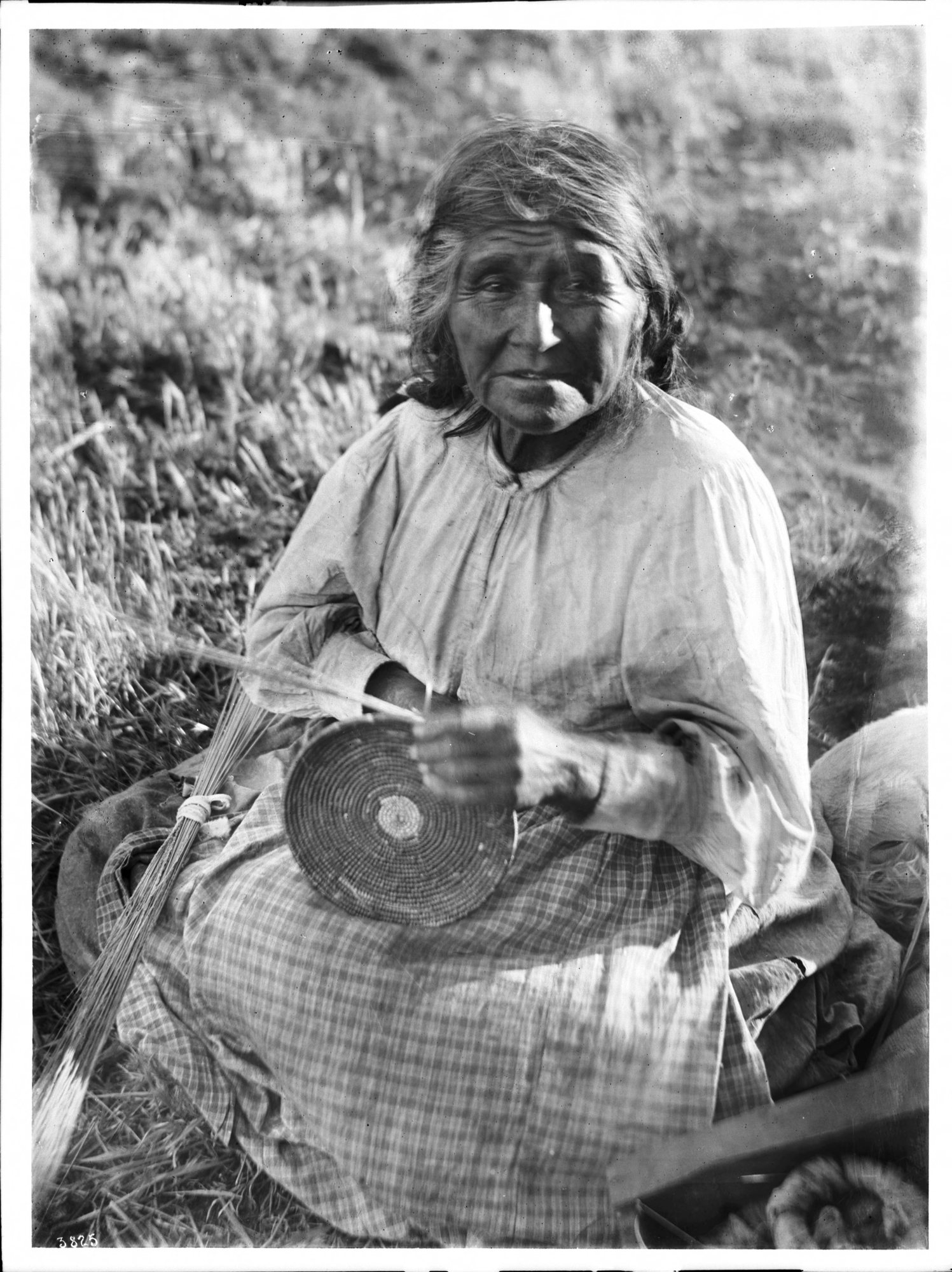
Natural grass stems and strong strips of plant material were used. In David Prescott Barrows's historical account (1900), the core of a coiled row consisted of a narrow bundle of grass. The working strip could be obtained, among other materials, from rush stems or finely split sumac branches. No artificial material was needed for this weave.
How the plant rows were joined
Several grass stems were gathered into one long, narrow bundle, forming the core of the first row.
A thinner strip of plant material was wound tightly around the bundle, gradually turning it into a spiral.
The working strip was passed through the neighboring lower row, then wound around the upper bundle again. Each pass joined the two rows.
Each loop was pulled tight. The neighboring rows fitted increasingly closely together as the basket wall gradually rose.
The spiral continued until the basket reached the required depth. In fine Cahuilla basketry, five to seven coiled rows could fit within one inch — about 2.5 centimeters.
This coiling method was recorded by an observer in Cahuilla settlements. The ability to transport water in particularly tightly woven baskets is separately preserved in the Augustine Band's own account.
How the baskets were used
Water collected from a spring or well was carried back to a camp in a woven vessel. Other natural water-holding places existed in Cahuilla country, including stepped wells called temakawomal, from which people obtained water for everyday needs.
A historical photograph
Around 1900, George Wharton James photographed Cahuilla basket maker Maria Los Angeles at work. The image shows an unfinished woven object in her hands, with prepared materials nearby.
Sources:
- Augustine Band of Cahuilla Indians, “History & Heritage,” “Basket-Makers” — https://tribe.augustinetribe-nsn.gov/history-heritage/
- David Prescott Barrows, The Ethno-Botany of the Coahuilla Indians of Southern California (1900), “Baskets and Basket-Making,” pp. 42–44 — https://upload.wikimedia.org/wikipedia/commons/d/d1/The_ethno-botany_of_the_Coahuilla_Indians_of_Southern_California_%28IA_ethnobotany00barrrich%29.pdf.