
In central and northern California, Miwok people used plant-fiber baskets of many sizes. Among them were very small vessels that could easily be held in the hand. People drank water and beverages made from manzanita berries from these little baskets.
Ethnographers Samuel Barrett and Edward Gifford described the objects in their 1933 book Miwok Material Culture. They recorded local names, the shape and purpose of the cups, and the dimensions of several museum specimens.
What the cup was made of
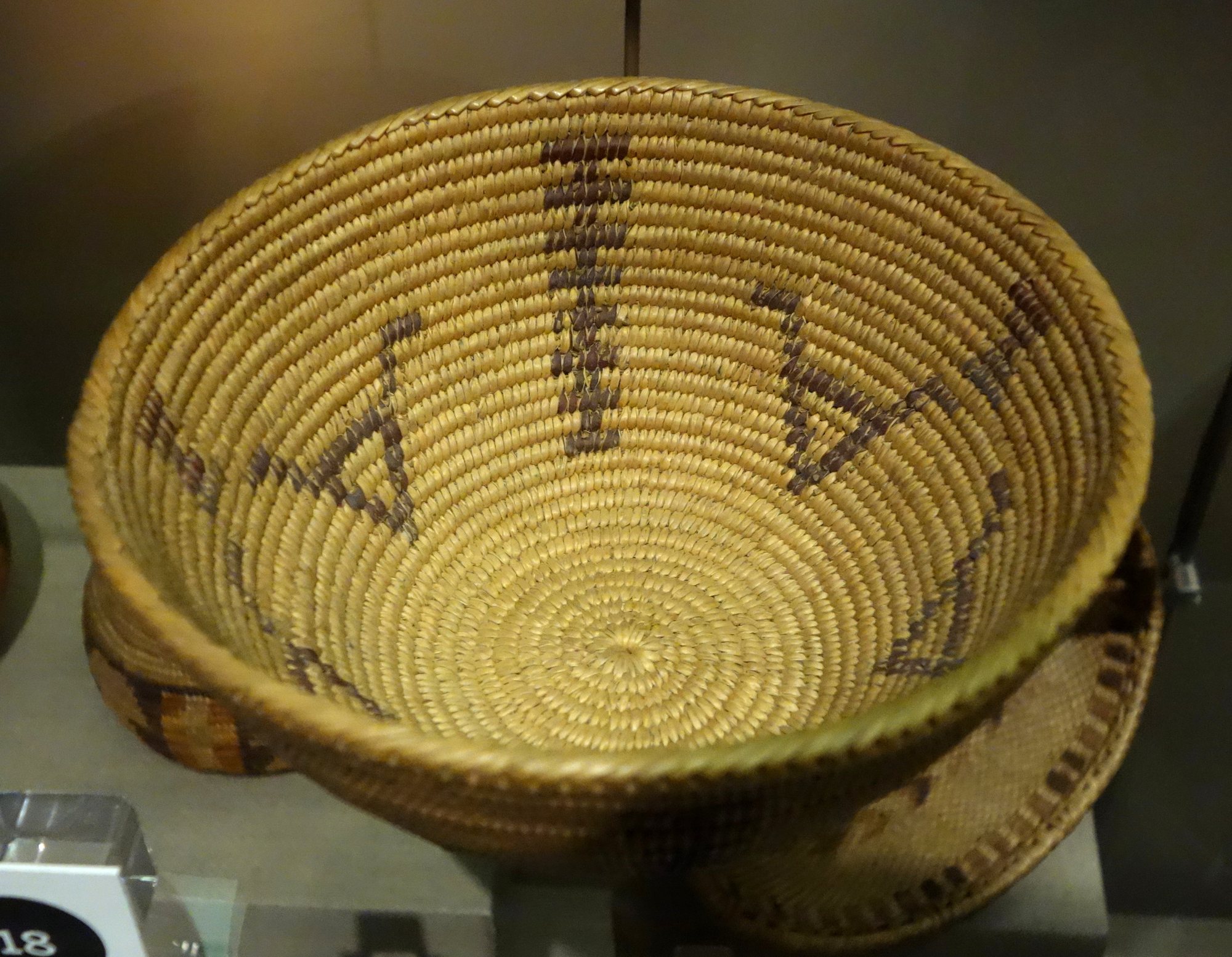
The cups were made from plant material using closely worked coiled basketry. Shoots or fibers were joined into a low, rounded vessel with an open top. Such a cup was quite different from the large baskets intended for cooking and storing food.
It could be brought to the water, used to scoop up a little, and raised to the mouth. The historical record explicitly states that the small baskets were used to drink water and manzanita beverages.
What the vessels were called
Different Miwok groups had their own names. Barrett and Gifford recorded pulī’sa among the Plains Miwok, pudī’sa among the Northern Miwok, pūlī’ssa and sō’tonō among the Central Miwok, and pūla’kka among the Southern Miwok.
The names varied by locality, but they described a similar kind of small woven drinking vessel.
Dimensions of actual cups
In their museum inventory, the ethnographers listed a Northern Miwok cup with a rim diameter of about 168 millimeters. Another Northern Miwok specimen was recorded as approximately 76 millimeters high.
Other sizes also existed, but both examples show small, hand-held vessels. These should not be confused with large baskets that could be used to cook food with heated stones.
What people drank from them
The cup could hold ordinary drinking water. It could also be used for a drink made from the berries of local manzanita shrubs and water. It was a versatile small vessel for everyday use.
The variety of woven vessels had a purpose: large baskets suited storage and food preparation, while small ones served for pouring and drinking.
What has survived
Researchers described and photographed real Miwok cups, listing several examples under museum catalog numbers. Other Miwok baskets have survived to the present as well, including a basket made before 1917 and now held by the Oakland Museum of California.
The museum object illustrates a genuine Miwok weaving tradition, although its use specifically as a drinking vessel has not been established. Information about the water cups themselves comes from the ethnographic record.
Historical source: S. A. Barrett and E. W. Gifford, Miwok Material Culture (1933), “Techniques,” descriptions, catalog numbers, and dimensions of small basket cups — https://www.yosemite.ca.us/library/miwok_material_culture/techniques.html.