
In the mountains and valleys of Northern California, the Yuki knew places where water emerged naturally from the ground. People visited these springs for drinking water. Some sources were not beside their homes and had to be reached on foot.
In 1944, anthropologist George Foster published detailed accounts of Yuki life collected during field research. His book A Summary of Yuki Culture preserves evidence of how people cared for their water sources.
Springs used by communities
Springs were associated with Yuki settlements. People knew where to find them and maintained the depressions from which they collected water. A good spring was highly valued, and its water was preferred to river water or water from an ordinary well.
Foster recounts a story connected with Ralph Moore's family. Moore's father did not want to drink water from a pump; instead, he walked about half a mile (roughly 800 meters) to his favorite spring. A familiar natural source thus remained important even after pumps had become available.
What people did at a spring
They cleared material that had accumulated in the spring's basin and made it harder to reach the water emerging there.
If the water was difficult to draw because the basin was too shallow, they deepened the depression.
They lined the edges with stones found nearby. The stone lining helped maintain the shape of the small watering place.
The result was an open basin connected to the natural point where groundwater reached the surface. This practice made use of the earth itself and stones found nearby.
Where the springs were
The account concerns Yuki lands in the northern part of present-day Mendocino County, including the Round Valley area. Among the mountains and wooded slopes were numerous small water sources. Residents of neighboring settlements knew their locations.
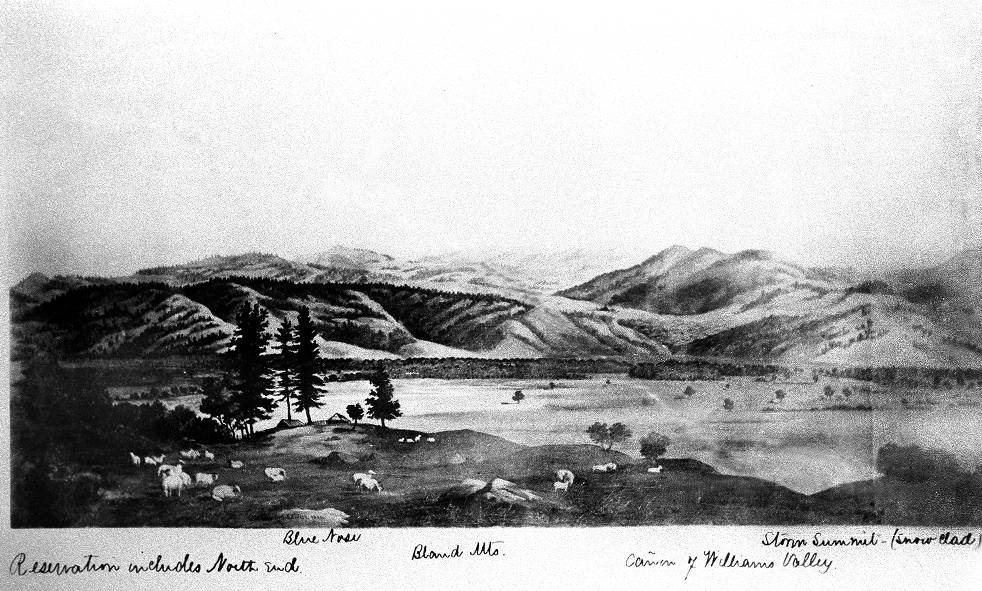
An archival panoramic photograph of Round Valley and its surrounding hills has also survived. It shows the natural landscape of the valley where the Yuki lived.
In Foster's account, a spring was not just a chance puddle left by rain but a familiar place that people looked after: they cleared it, deepened it when necessary, and maintained its stone edging.
Historical source: George M. Foster, A Summary of Yuki Culture (1944), printed p. 173 — https://digicoll.lib.berkeley.edu/record/84123/files/ucar005-004.pdf.