
Ohlone and Coast Miwok communities have long lived along the shores of San Francisco Bay and the neighboring coastline. They made baskets from plant materials for everyday use. These objects served different purposes: some held food supplies, while others were used to store water.
The National Park Service historical overview “Ohlones and Coast Miwoks” explicitly mentions baskets made for food and water. These vessels were part of life in settlements where local vegetation supplied materials for weaving.
Why a container was needed
Water could be found in streams, springs, and other natural places. But it still had to be brought to the place where people lived and kept their supplies. They used portable vessels for this purpose. A basket made of natural materials could form part of a household alongside other objects made from plants.
Unlike a heavy stone basin, a woven container was movable. It could be carried when people traveled between camps, kept near other supplies, or used within a settlement.
Where the basket makers lived
South of the Golden Gate, the lands of different Ohlone groups extended as far as the Monterey coast. To the north, Coast Miwok communities lived in what is now Marin County and southern Sonoma County. Their settlements included bay shores, coastal lagoons, and areas along streams.
Families used both permanent and seasonal settlements. In each, woven objects helped them handle everyday supplies.
What survives today
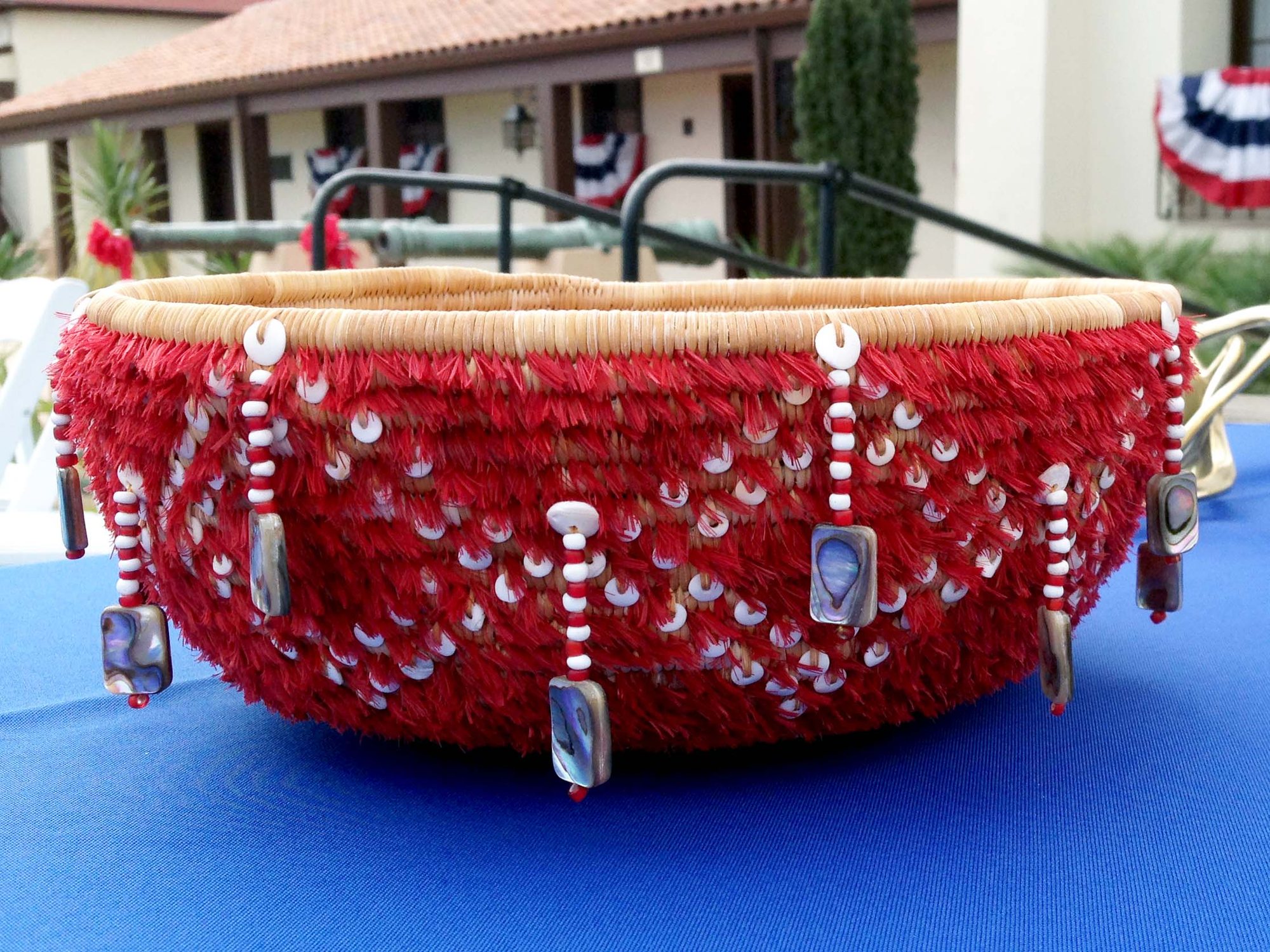
Weaving remains a living tradition among contemporary Ohlone artists. For example, Linda Yamane, a Rumsen Ohlone artist, made a basket that was presented to the Presidio Officers’ Club in San Francisco in 2014. A National Park Service photograph shows an authentic contemporary basket made by an artist of this people.
The object in that photograph has not been identified as a water vessel. It illustrates the continuing tradition of plant-fiber weaving; the historical use of baskets to hold water is established separately by the National Park Service text.
Woven water containers were part of centuries of knowledge about plant materials. The historical overview records their purpose, although it does not describe the exact shape or dimensions of a water basket or explain how an individual maker rendered a particular vessel capable of holding liquid.
Historical source: National Park Service, “Ohlones and Coast Miwoks,” everyday life section — https://home.nps.gov/goga/learn/historyculture/ohlones-and-coast-miwoks.htm.