
Photographer Charles Chester Pierce left a rare image of a Chemehuevi sleeping place. In it, a man rests near his fields beneath a light arch made of branches. Instead of a familiar bed, there is a platform of long wooden poles raised above the ground.
How the sleeping place was arranged
The first feature that catches the eye is the lower platform. Long poles and branches lie side by side, forming an elongated surface large enough for a person. The platform is raised off the ground, leaving an open space below it.
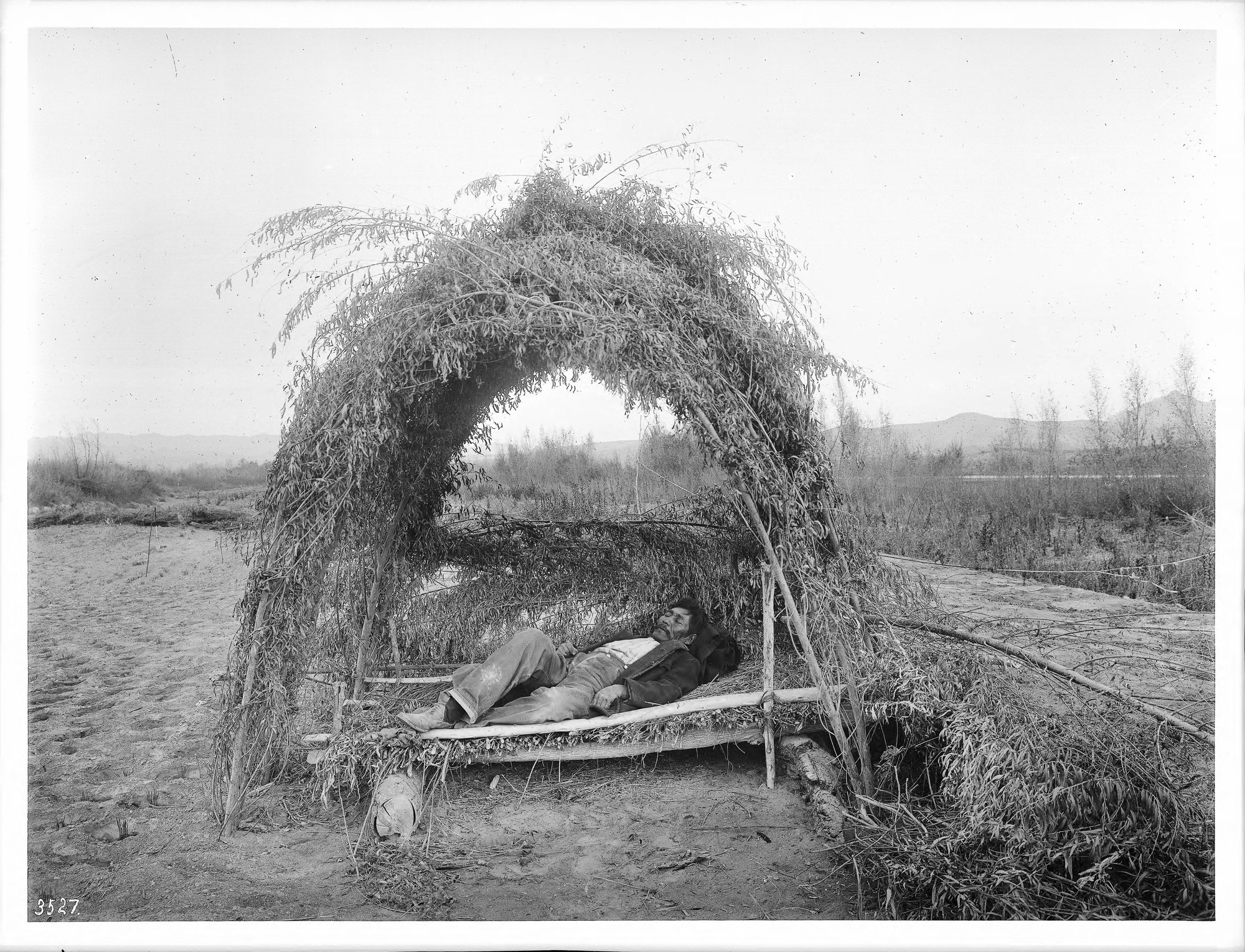
Above is another structure: an arched shade shelter. Bent branches create a rounded line overhead, with their ends resting on either side of the sleeping place. The arch provides shade, but it is not an enclosed house; air can move freely along the sides.
A folded blanket lies beneath the sleeper's head. The historical caption explicitly calls it a pillow. The bed thus consisted of a few simple things: a wooden platform, a branch shade shelter, and a soft folded covering beneath the head.
Where and when
The photograph dates to approximately 1900. In the California Historical Society archive it is described as the sleeping place of a Chemehuevi man while tending his fields. The setting is associated with the desert region around Palm Springs.
This photograph preserves a real way of arranging daytime rest: sleeping above the ground on a platform of branches, sheltered from the sun by an arch of plants.
Historical photograph: Charles C. Pierce, “Chemehuevi Indian man sleeping in his sleeping shelter in the field,” circa 1900, California Historical Society, CHS-3527 — https://commons.wikimedia.org/wiki/File:Chemehuevi_Indian_man_sleeping_in_his_sleeping_shelter_in_the_field,_ca.1900_(CHS-3527).jpg.
