
In desert settlements of Southern California, Cahuilla people built round houses called kish. Their roofs began close to the ground and rose in a dome over the living space. Instead of long logs and stone masonry, these houses used flexible branches and plants that grew near water.
Some kish houses measured 15–20 feet across, about 4.5–6 meters. Inside was an earthen floor with a place for a hearth and an area where a family rested and slept.
What the house was made from
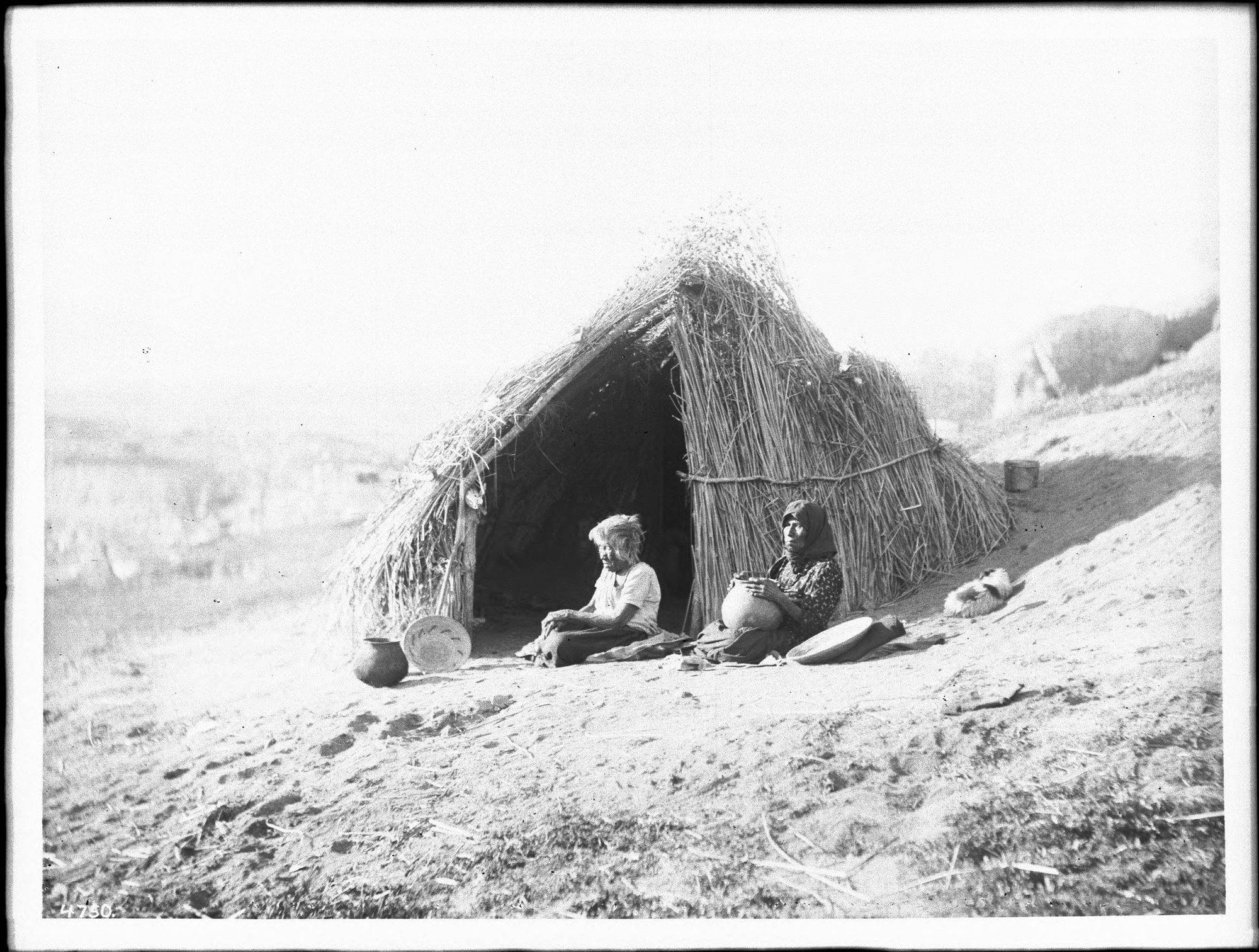
Long willow branches formed the main structure. They were bent to create a rounded framework. Whatever plant covering was available was placed over the outside: long wetland tule stems, fan-palm leaves, or other local plants. Tule was also woven into mats for the floor and entrance.
How the domed kish was assembled
A level place was chosen, and the round outline of the future dwelling was marked out.
Long, flexible willow branches were bent inward to form a dome above the site.
Plant materials were laid over the branch framework. Tule was used near marshes; in areas with palm oases, large fan-palm leaves were available.
An entrance was left at the front and could be closed with a tule mat.
An opening was left near the top of the roof for smoke from a hearth in the middle of the earthen floor to escape.
Tule mats were spread inside. They covered the ground and provided places to sit and rest.
What a real house looked like
Around 1900, photographer George Wharton James photographed two Cahuilla women in front of their kish. Behind them, the photograph shows a closely covered, rounded dome with a plant roof. The women sit on coverings, with baskets and clay vessels nearby.
Mountain Cahuilla communities also had other dwellings, including rectangular samat houses made from tall poles. The round kish was a distinct structure: its framework relied on bent willow branches rather than straight walls and a longitudinal beam.
Sources: “The Cahuilla Indians,” California State University, San Bernardino, “Shelter” — https://www.csusb.edu/sites/default/files/Unit_3.2_Cahuilla_Student_Reader.pdf; Santa Rosa Band of Cahuilla Indians, “Culture” — https://new.santarosacahuilla-nsn.gov/culture.html. Historical photograph: George Wharton James, CHS-4750 — https://commons.wikimedia.org/wiki/File:Coahuilla_Indian_women_in_front_of_their_%22kish%22_California,_ca.1900_(CHS-4750).jpg.
