
Among the Coast Miwok, a small family dwelling was called a kotcha. It protected people from bad weather and provided a place to sleep. The materials depended on what grew nearby. Where large redwoods were available, broad strips of bark were used. Around Point Reyes, where redwood bark might not be available, houses were built from willow poles and the wetland plant tule.
The willow framework
Long willow poles were collected to form the foundation of the house. They made up the framework of a small dwelling. Bark was stripped from the poles, and joints were secured with plant-fiber ties. This created a structure that could be covered with long wetland stems.
Gathering tule
Tule grew near water, in marshes and along shallow banks. Its long stems were harvested in nearby wetlands and carried to the house under construction. On the finished framework, they became an outer covering against wind and rain.
How the kotcha came together
People chose a place for a small family dwelling and determined the area that needed to be covered by the roof.
A framework of willow poles was assembled, establishing the shape of the future house.
Bark was stripped from the poles, and the poles were tied together.
Tule stems gathered in the marshes were laid over the framework, gradually covering the walls.
The plant covering was made dense. To protect against winter rains, it was as much as two feet thick — approximately 60 centimeters — in some places.
An entrance was left in the covering so people could go inside.
The interior served as a place to rest at night. Coast Miwok kotcha dwellings are known to have had slightly sunken earthen floors covered with woven tule mats and hides.
Another type — the bark house
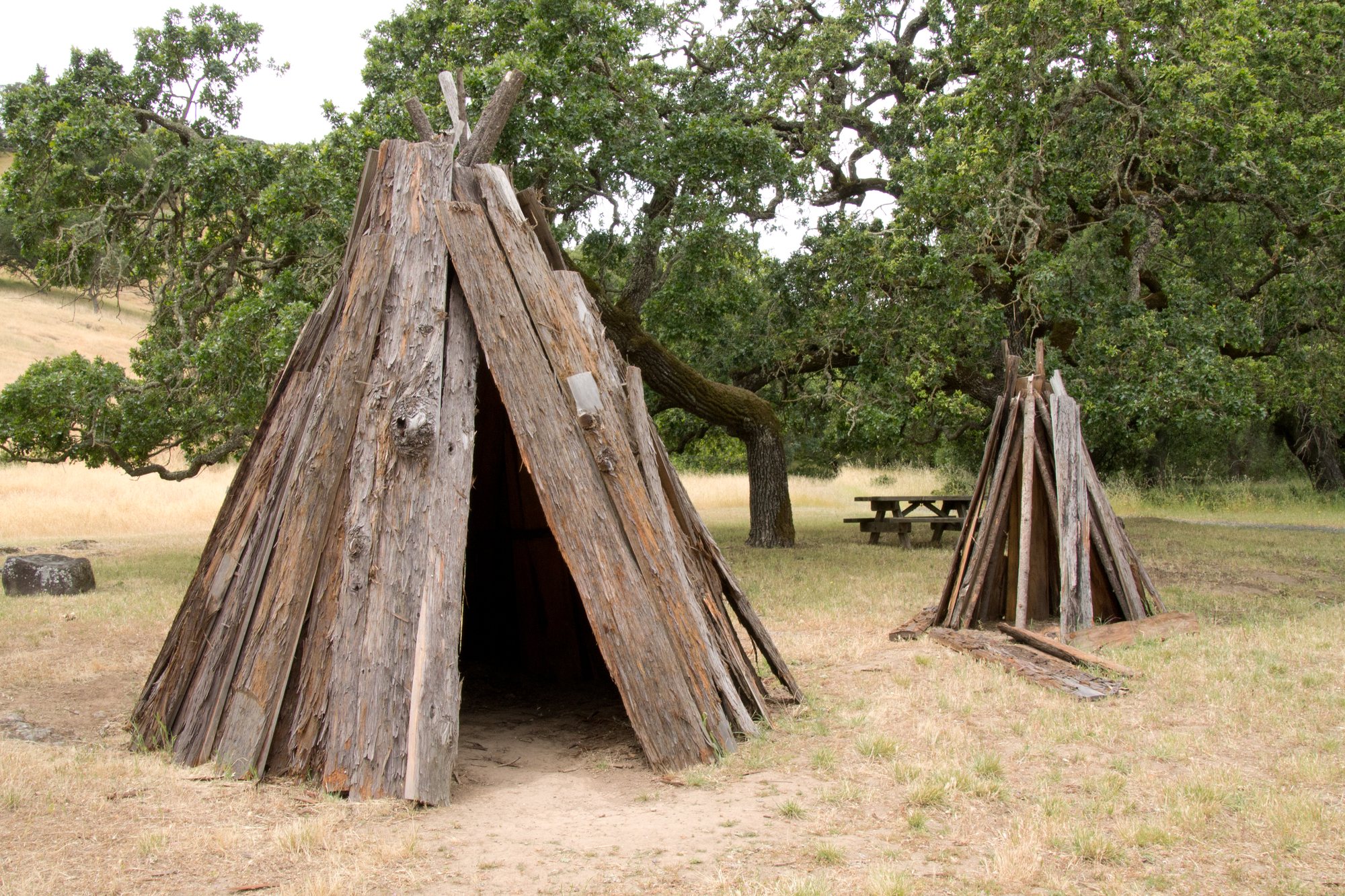
In coastal forests, the Miwok also built kotcha dwellings with frameworks made from strong Douglas-fir poles. These poles were tied with vines, while broad strips of redwood bark covered the exterior walls and roof. Soft mats and hides were spread on the earthen floor inside.
The form of a dwelling was closely connected to the environment around the settlement: willow and tule in wetland areas, and bark and sturdy wooden poles in the forest.
At Olompali State Historic Park, reconstructed Coast Miwok dwellings covered in plant materials can be seen today. A modern photograph shows their silhouette and outer tule covering.
Historical source: National Park Service, “Guide to the Miwok Village: Kule Loklo,” sections “Tule House” and “Redwood Bark House” — https://npshistory.com/publications/pore/brochures/miwok-village.pdf. Photograph: Sarah Stierch, Olompali State Historic Park, 2016 — https://commons.wikimedia.org/wiki/File:Miwok_dwellings.jpg.
