
On Kumeyaay lands in Southern California, people built dwellings with rounded roofs and low entrances. One such house was called an e’waa. Its shape was made not from heavy logs but from long, flexible branches bent toward one another. A covering of plant materials was laid over the framework.
Tule — wetland plants growing near fresh water — was especially suitable for rainy weather. Dried stems allowed air to move between the fibers, while the fibers swelled when wet, making the outer layer denser.
What the house was made of
Willow. Long, flexible branches formed the dome's foundation. They served as upright supports and curved inward, meeting near the top of the dwelling.
Plant-fiber ties. Strong cords made from yucca or agave fibers held the poles together and secured the outer covering.
Tule. Long wetland stems were gathered, dried, and tied into bundles. In rainy weather they covered the framework, gradually forming a dense roof.
Stones. Stones were arranged around the outside edge of the dwelling. This ring made it more difficult for small animals to enter.
How the dome was assembled
A site was selected and a circular outline marked out for the dwelling. Long willow branches were positioned along this circle.
The lower ends of the branches were fixed into the ground. The branches were bent inward to create a rounded form above the middle of the site.
The upper parts of the framework were joined with plant-fiber cords. Additional crosswise branches were tied to the principal arches.
Tule stems were gathered and left to dry. They were then tied into bundles suitable for fastening to the framework.
The bundles were tied progressively to the outer arches, covering the sides and top of the house. A separate opening was left for the entrance.
Stones were laid around the lower edge. In some dwellings, soil and clay were also packed against the lower part of the walls.
Tule mats were spread over the earthen floor inside. They provided places to sit and sleep.
The covering could vary by location and season. Looser brush was also used in dry weather, while tule was chosen where a denser layer was needed for protection against rain.
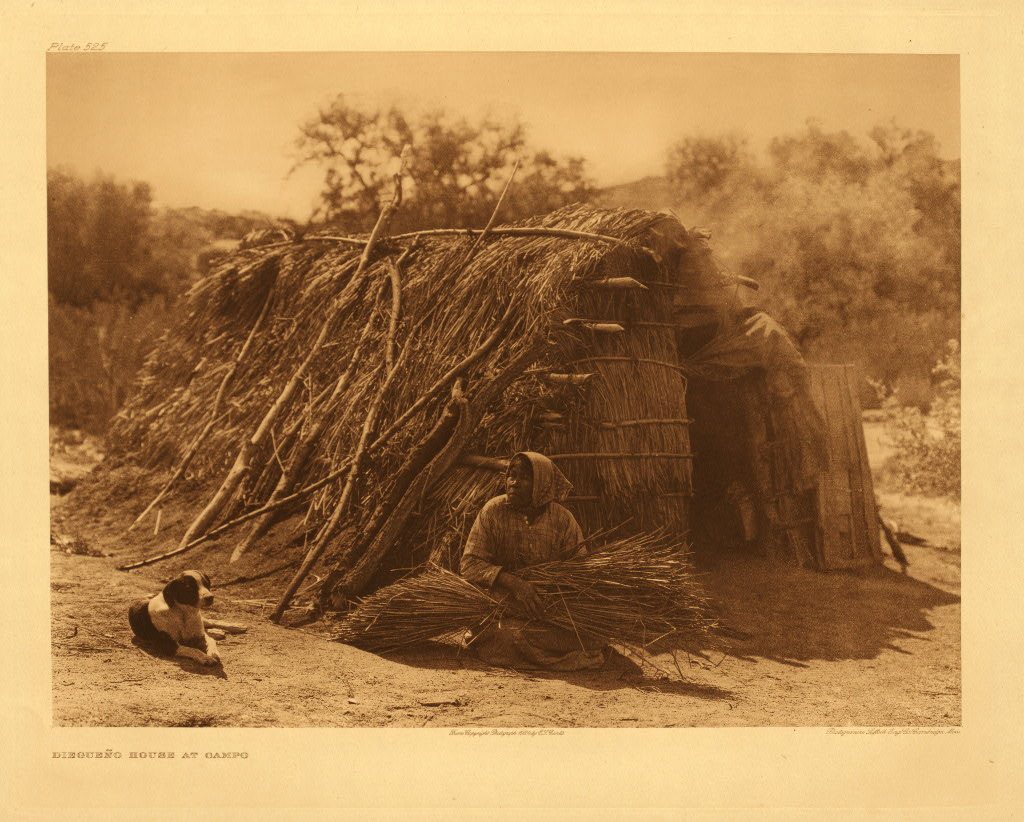
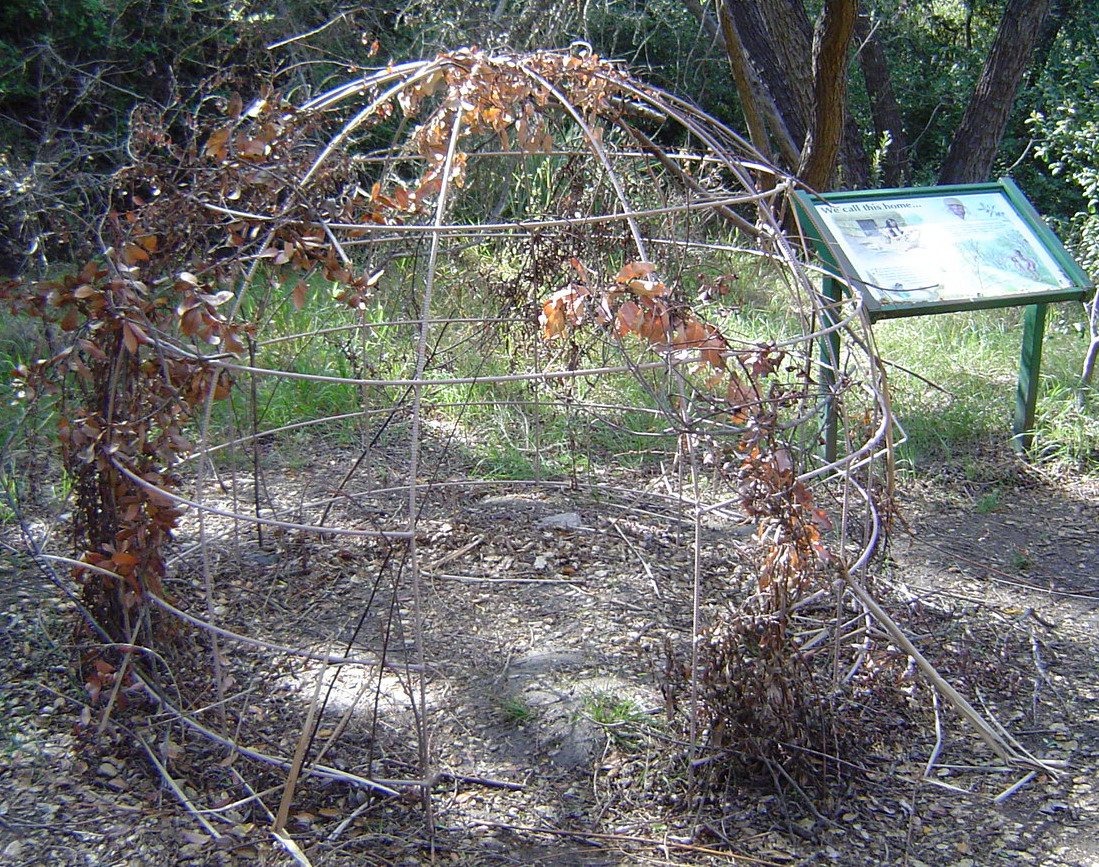
A photograph published in Edward Curtis's historical collection in 1926 shows a Kumeyaay woman beside a house in Campo. Its finished shape and plant covering are visible. A modern photograph titled Kumeyaay Home, taken in 2006, shows another example of this kind of structure.
Sources: Kumeyaay Diegueño Land Conservancy / Sycuan Band of the Kumeyaay Nation, “Learning Landscapes,” section on the e’waa — https://www.parks.ca.gov/pages/663/files/LearningLandscapes_Edited_20201120v1c%20REMEDIATED.pdf; “A Teacher’s Guide to Historical and Contemporary Kumeyaay Culture,” section 1.5, Shelter — https://mtrp.org/wp-content/uploads/2024/08/kumeyaay_teachers_guide.pdf.